Touchscreens on Laptops: A Genuine Need or Unnecessary Expense?

When is a touchscreen actually useful?
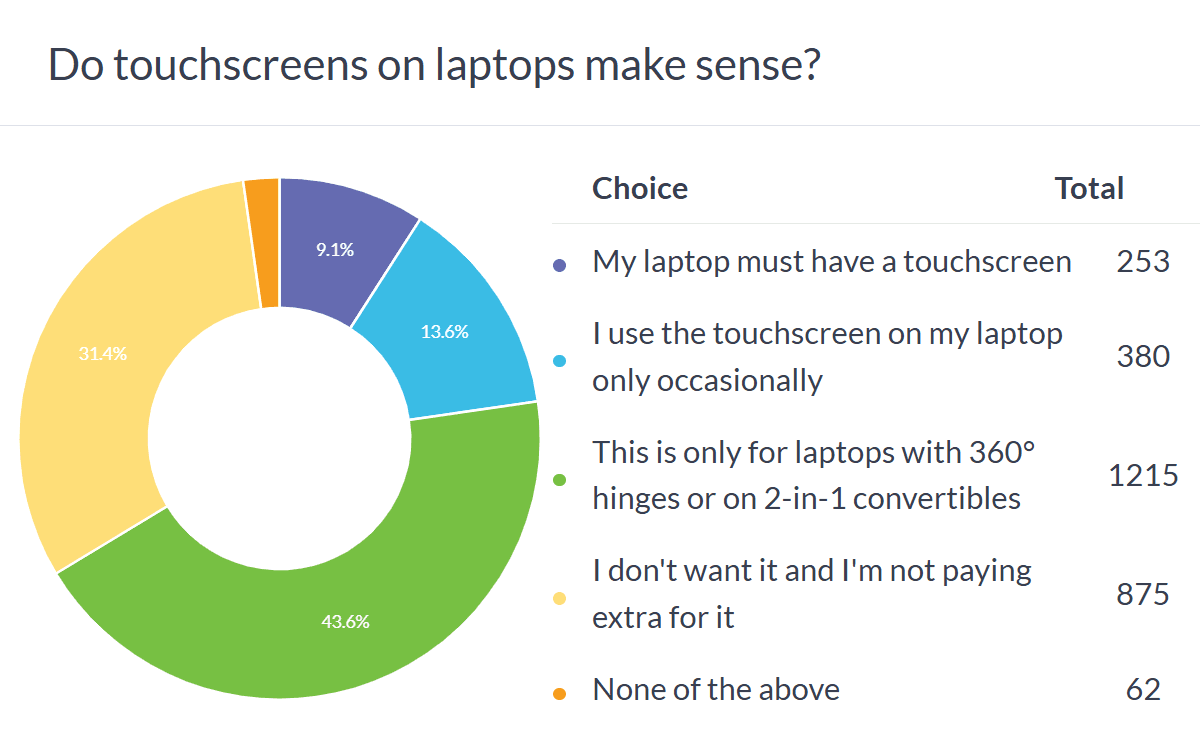
Opinion in the tech world remains divided regarding touchscreen laptops. A recent study suggests that a large portion of users only find touch functionality practical if the device features a 360-degree hinge or a detachable screen. Essentially, this applies to the category of laptops that double as tablets.
According to respondents, touchscreens significantly speed up navigation, particularly for those who dislike using a traditional touchpad. Furthermore, the feature is indispensable for creative professionals—artists, designers, and developers—who require direct interaction with the screen to perform specific tasks.
An economic approach and alternative views
Another large group of users is categorically against touchscreens on laptops. Their primary argument is financial: people do not want to pay extra for a feature they will practically never use. This position is logical, as the tech market often introduces additions that increase the final product's cost without improving the user's daily routine.
Interestingly, there is a group of users who utilize touchscreens on laptops that do not convert into tablets. This segment accounts for about a quarter of those surveyed, yet the majority admit they only use the feature sporadically. The number of regular users does not even reach 9%, confirming that touch control has yet to become a standard in the classic laptop form factor.
Manufacturer challenges: Apple, Google, and Microsoft
Major tech companies are adopting different strategies regarding this issue. In Apple's case, the release of a touchscreen MacBook would be a logical step, though the choice of form factor remains debated. Since macOS can run iPadOS applications, a MacBook with a 360-degree hinge would make more sense. Conversely, reaching out to touch the screen of a laptop sitting on a desk is less comfortable for users.
Google's "Googlebook" project (Android-based laptops) also raises questions. Although Android is built for touch interfaces, it has yet to fully establish itself as a laptop system. This is compounded by the existence of ChromeOS, which confuses users when making a choice. Microsoft, for its part, attempted to introduce a touch interface with Windows 8 back in 2012, yet the Windows interface in tablet mode remains unrefined to this day.
Ultimately, touchscreen laptops will likely remain a niche product for a long time. For users who primarily rely on laptops for work or study, performance and keyboard ergonomics remain higher priorities than the ability to tap on the screen.