The Tesla Roadster’s 'Flying' Capabilities: Reality or Marketing Gimmick?
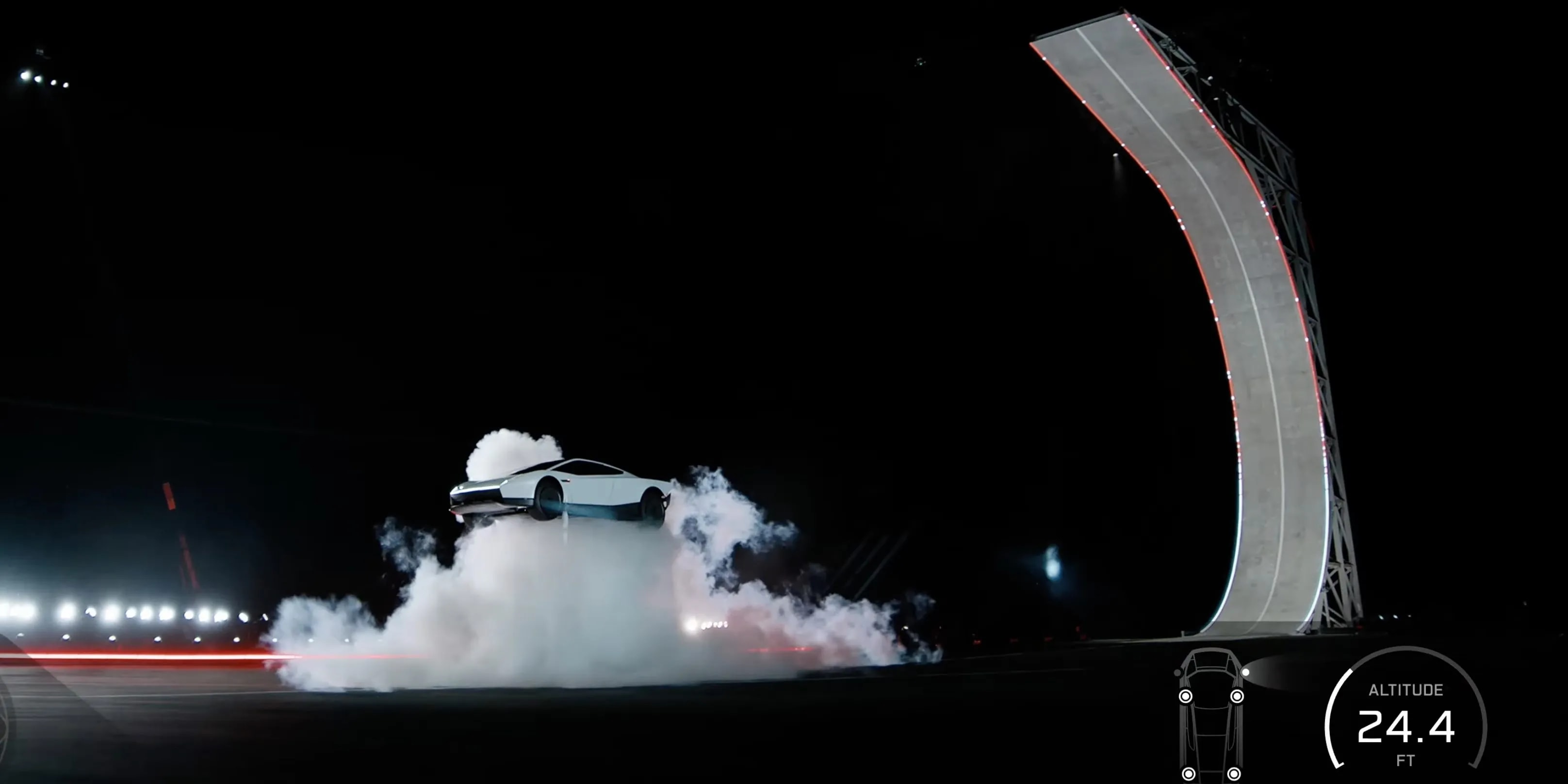
After years of anticipation, Tesla has finally released details regarding its next-generation Roadster. Originally announced in 2017 as a vehicle intended to replace gas-powered sports cars, the concept has now entered a near-fantastical dimension. According to Elon Musk, the new model offers not only record-breaking acceleration but also the ability to fly. ## A Technological Marvel or a Challenge to Physics? During the demonstration, Tesla showcased several impressive feats: the car moved vertically, drove upside down, and even performed jumps in the air. These capabilities rely on two primary technologies: a multi-mode suction system and cold gas thrusters. The suction system, which functions similarly to the McMurtry Spierling, creates a low-pressure zone beneath the vehicle. This allows it to 'stick' to the surface, providing unprecedented stability in corners. However, Tesla’s claim of 4,700 kg of downforce appears highly questionable and may be somewhat exaggerated. ## Rockets in a Car The 'Rocket' package has garnered the most attention. Instead of standard rear seats, the cabin houses gas tanks that use cold gas thrusters to lift the vehicle. While performing a 'kickflip' in the air looks impressive, experts note that such jumps do not improve vehicle performance; on the contrary, the additional weight and complex system make the car heavier and hinder acceleration. Nevertheless, the rear-mounted thrusters serve another purpose. Tesla claims its system achieved 0-100 km/h acceleration in under one second. This is reportedly accomplished by an 80-kilonewton jet stream that pushes the car forward once the mechanical grip of the tires is exhausted. ## What Does This Mean for the Consumer? Despite bold promises, questions remain. In 0-100 km/h acceleration tests, details such as the 'one-foot rollout' method—which excludes the initial phase of acceleration—are critical. It is also unclear how quickly the gas thrusters react and how much time they require to 'spool up.' While Tesla's demonstration was impressive, it remains unknown how practical this technology will be in daily life. For enthusiasts tracking the evolution of electric vehicles, this news confirms that electric transport is moving ever closer to the realm of science fiction. However, it seems there are still many technical barriers to overcome before these 'flying' cars appear on real roads.