Stellar Collisions: How 'Impossible' Black Holes Are Born
A New Explanation for a Cosmic Mystery
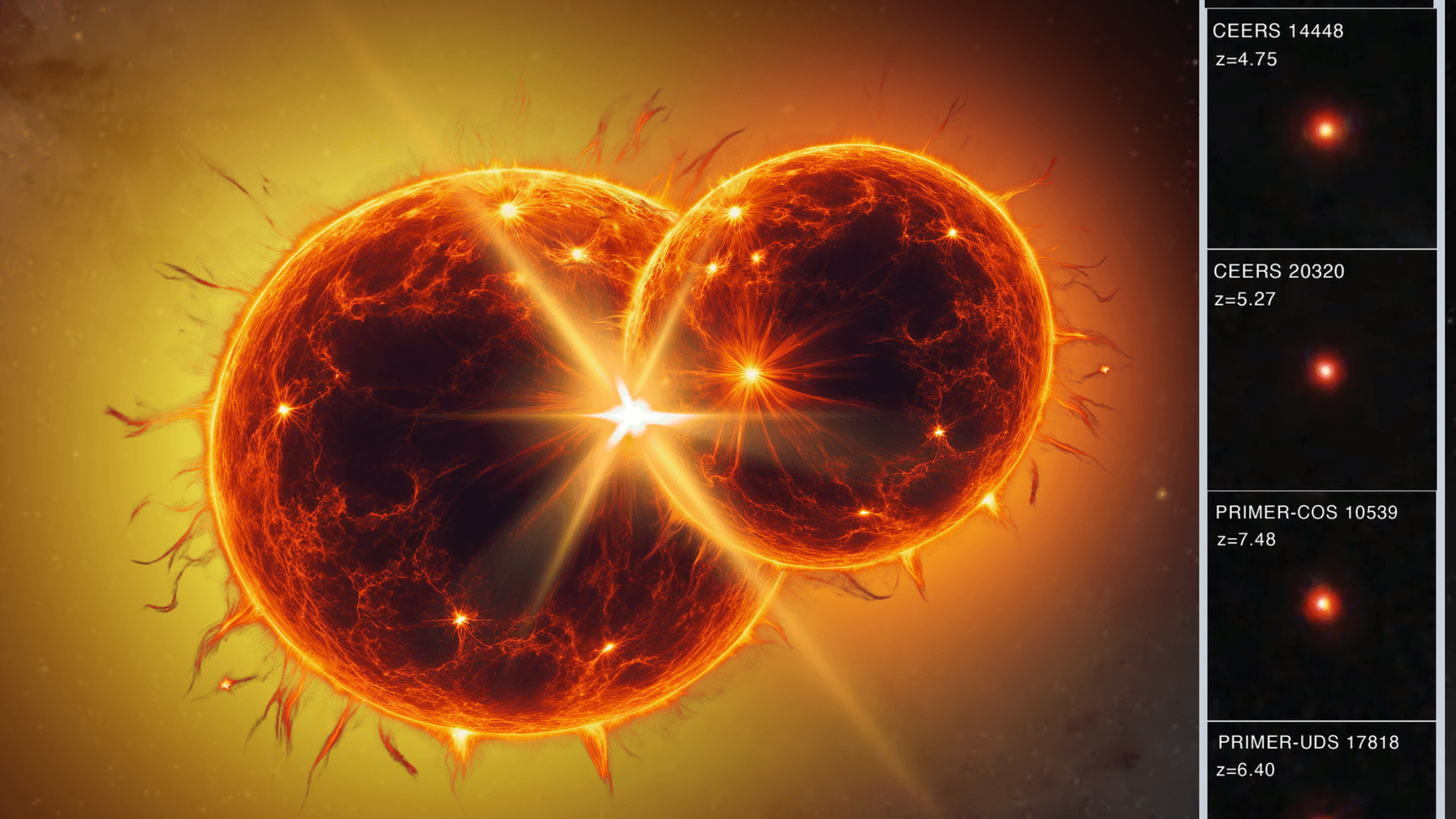
Phenomena discovered by the James Webb Space Telescope (JWST), which astronomers call 'Little Red Dots,' have long puzzled scientists. According to new research, the rapid growth of these mysterious objects and the supermassive black holes of the early universe may be driven by frequent and catastrophic stellar collisions.
A team of researchers from the University of California, Los Angeles (UCLA) conducted computer simulations of the early universe. The results demonstrated that stellar systems in the nascent stages of the cosmos were so densely packed that collisions between stars were a common occurrence. If these collisions occurred at a slow pace, the stars would merge to form giant, supermassive stars, which would eventually collapse into black holes at the end of their life cycles.
The Birth of Black Holes
One of the main puzzles for astronomy has been the fact that supermassive black holes existed less than a billion years after the birth of the universe. According to standard models, they should have required significantly more time to reach such sizes. UCLA researcher Claire Williams explains that the most striking result of the simulations is that stars merge multiple times to create a single star with a mass equivalent to an entire star cluster. These 'monsters' serve as the seeds for intermediate-mass black holes, which subsequently evolve into supermassive black holes.
Such processes no longer occur in the centres of modern galaxies. The reason is simple: supermassive black holes are already present, and their gravity accelerates stars, making collisions destructive rather than constructive. However, the environment of the early universe was entirely different and chaotic.
What Are the 'Little Red Dots'?
The 'Little Red Dots' discovered by JWST disappeared after the universe reached an age of 2 billion years. Researchers believe these objects may be the very dense star clusters where these intense collisions took place. As the universe expanded and cooled, these regions gained equilibrium and stability, which eliminated the extreme conditions necessary for the existence of the 'Little Red Dots.'
This study, published in the Astrophysical Journal, helps scientists better understand how the chaotic early cosmos transformed into the orderly galactic structures we know today. For astronomy enthusiasts, this is significant news, as it demonstrates just how dynamic and volatile the universe was at the dawn of its existence.