Potential New Dwarf Planet Discovered in Our Solar System
A New Discovery in the Deep Cosmos
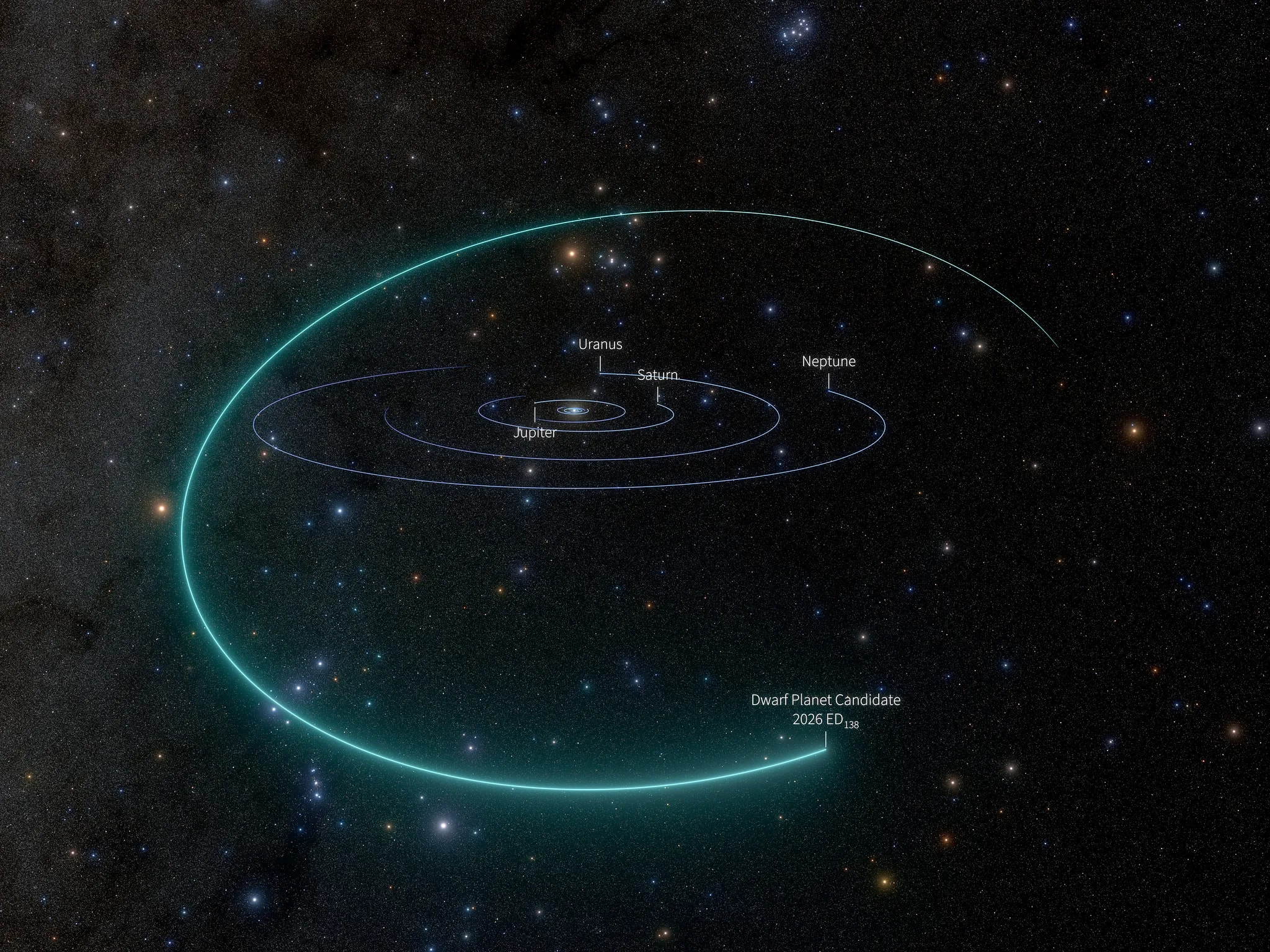
There is significant news in the world of astronomy: researchers at the Vera C. Rubin Observatory in Chile have identified a potential new dwarf planet in our solar system. Scientists discovered the object, temporarily designated 2026 ED138, in mid-October while analysing data collected by the observatory. Matthew Holman, a researcher at the Harvard-Smithsonian Center for Astrophysics, located records dating back to 2016, which allowed for the reconstruction of the object’s ten-year trajectory.
2026 ED138 belongs to a category of objects located beyond Neptune. Its diameter is estimated to range between 600 and 1,500 kilometres, and it is located approximately 46 astronomical units from the Sun. For comparison, Pluto orbits at an average distance of 40 astronomical units from the Sun. Although this celestial body is one of the brightest and largest in its category, it remained unnoticed until now because its position lies against the backdrop of the Milky Way disc, where the light of millions of stars makes it difficult to spot other objects.
What Defines a Dwarf Planet?
The primary difference between a planet and a dwarf planet lies in the environment of their orbit. Both possess enough gravity to assume a spherical shape, but a true planet clears its orbital path of other objects of similar size. Dwarf planets, such as Pluto, Haumea, Makemake, Eris, and Ceres, coexist with many other objects in their orbital region.
For 2026 ED138 to be officially recognised as a dwarf planet, scientists must determine its size and shape more precisely. It is essential to confirm that the object has enough mass to maintain a spherical shape. Identifying such objects is a complex process in astronomical research, as approaching them to capture detailed images is nearly impossible without space probes. For example, the New Horizons mission took nearly nine years to reach Pluto.
What Does This Discovery Mean?
The solar system is a much more vast and diverse structure than is often depicted in textbooks. The Kuiper Belt and the scattered disc beyond Neptune contain thousands of small and large bodies. Researchers acknowledge that 2026 ED138 is not unique; there are dozens of other candidates, such as Gonggong, Quaoar, Sedna, and Orcus, which may be added to the official list of dwarf planets in the future.
Although this discovery does not directly affect our daily lives, it serves as a reminder of how much remains unknown about our immediate cosmic neighbourhood. Each such object helps scientists better understand the formation and evolution of the solar system. In the near future, scientists will continue processing data to determine whether 2026 ED138 will take its place among the officially recognised dwarf planets of the solar system.