OpenMobile-2: The AI Agent That Controls Your Smartphone
Closing the gap between open-source models and closed systems.
One of the primary challenges in artificial intelligence development is enabling autonomous interaction with smartphone applications. A research team has taken a significant step forward with the introduction of OpenMobile-2, a suite of open-source models designed to enhance the capabilities of smartphone agents and bridge the gap with closed systems.
Diversity Matters More Than Data Volume
According to the authors of the study, the effectiveness of an AI agent does not depend solely on the volume of data. Instead, the diversity of applications on which the model is trained is a decisive factor. Researchers have demonstrated that, given a fixed amount of data, expanding the spectrum of applications directly improves the agent's ability to execute tasks in unfamiliar software.
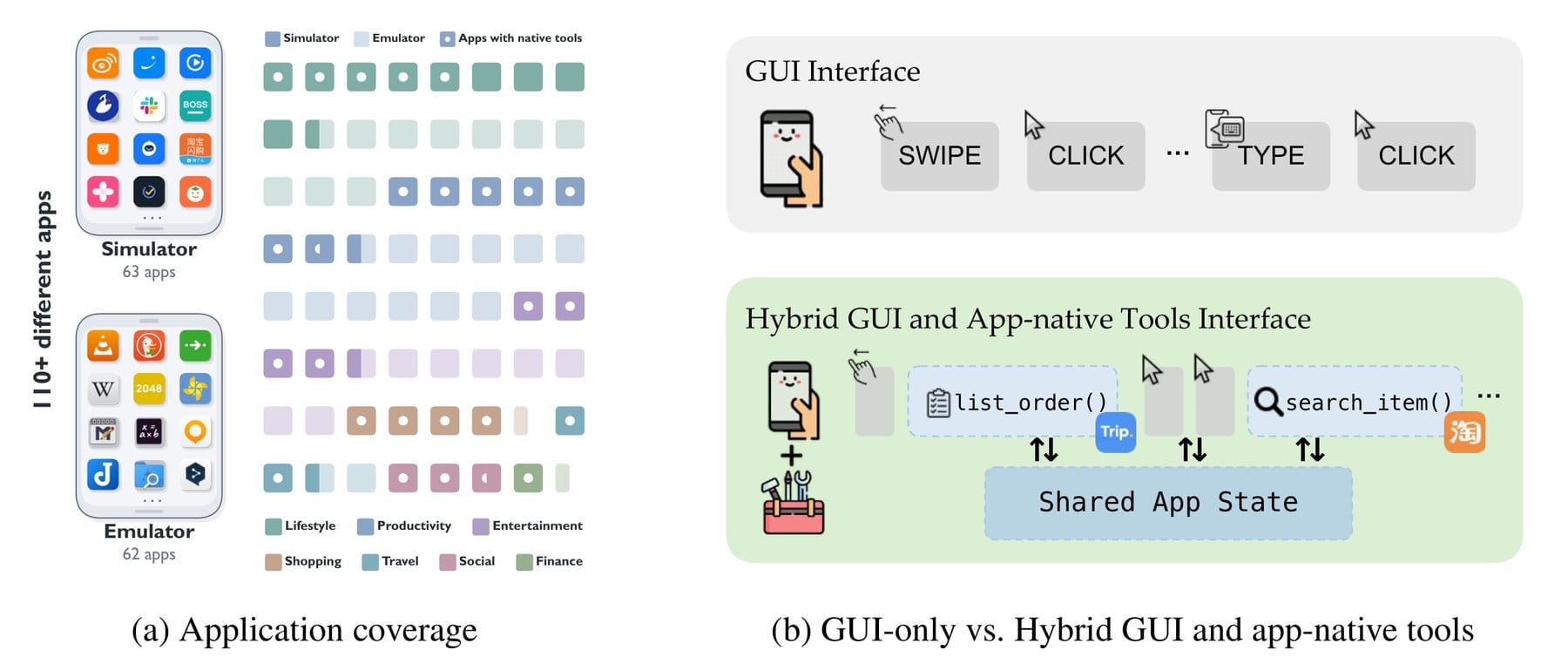
OpenMobile-2 is based on the Qwen architecture and is available in two versions: 9 billion and 27 billion parameters. The project is unique because the researchers created simulated versions of 35 popular applications, including services such as Google Drive and Slack. In total, the agents are trained on over 110 applications, allowing them to better navigate user interfaces.
How the Agent Learns
Automating smartphone applications is a complex process, as loading data or logging in and out of real apps is often cumbersome. Researchers solved this by creating a simulated environment where the system resets to its initial state after every session. The agent only views screen captures and does not have access to the application's internal database, making its operation as close to human behavior as possible.
Interestingly, the models were trained using examples generated by Google's Gemini 3.1 Pro. As a result, OpenMobile-2 showed significant progress during testing. For example, on the AndroidWorld benchmark, the score of the 27-billion-parameter model increased from 67.1 to 79.9, while in the real-device-based SPA-Bench test, the result nearly doubled.
The Future: Direct Commands or Interface Reading?
As part of the study, a direct command function (such as "add to cart") was introduced experimentally, so the agent does not need to navigate through menus. It was found that after proper training, agents using this method perform tasks 10% more efficiently and require fewer steps.
Although the technology is still evolving, the open nature of OpenMobile-2 lays the foundation for more flexible and independent smartphone assistants in the future. For users, this means that in the coming years, we may see smarter virtual assistants capable of automatically distributing data between applications and performing routine tasks on our behalf.