November Sky Guide: 5 Planets Visible to the Naked Eye
November is a month packed with astronomical events, making it an ideal time for both novice and experienced observers to track planets. This month, five planets are visible in the night sky: Saturn, Mars, Jupiter, Venus, and Mercury.
The Evening Star: Saturn
If you are planning your observations for the evening, Saturn is your primary target. It is positioned quite high in the southern sky and remains easily visible throughout the month. Saturn is distinguished by a steady, yellowish glow that sets it apart from the stars. When viewed through a telescope, its famous ring system is tilted at approximately 6.5 degrees from Earth, allowing for a clear view of its details. On 18 November, Saturn will appear near the Moon, making it even easier to locate.
The Morning Show: Venus and Mercury
In the morning, before sunrise, the sky is particularly spectacular. Venus, which grows brighter throughout the month, shines like a silver lamp on the east-southeast horizon. By the end of November, Venus rises nearly 3.5 hours before the Sun and climbs quite high in the sky. On 7 November, Venus, a waning crescent moon, and the star Spica will appear very close together in a small cluster.
Mercury, which is rarely seen in Earth's sky, will appear from the second half of the month. On 20 November, the planet will reach its maximum western elongation from the Sun, making this one of the best periods of the year for observation from the Northern Hemisphere. It will appear below and to the left of Venus, resembling a bright star.
Mars and Jupiter: A Dynamic Duo
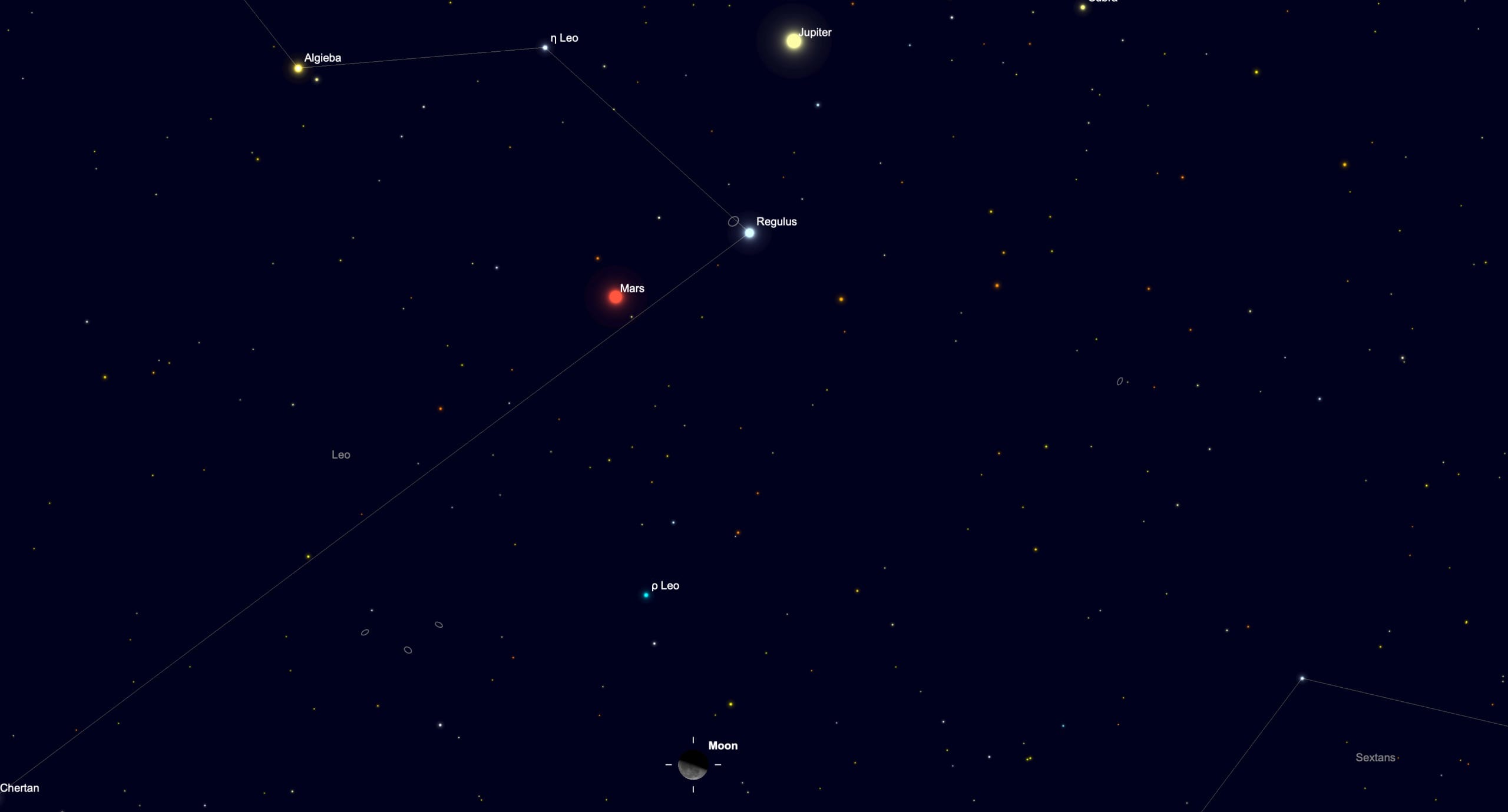
After midnight, Mars and Jupiter dominate the sky. These two planets are moving in the direction of the Leo constellation, and their relative positions change throughout the month. On 16 November, Mars will pass by Jupiter, bringing them very close together. Jupiter, as a gas giant, is significantly brighter than Mars, though both are clearly visible to the naked eye. In the final days of November, from 29 to 30 November, Jupiter, Mars, the Moon, and the star Regulus will gather in the same space, creating a spectacular astronomical grouping.
When searching for planets, remember a simple method: a spread hand held at arm's length corresponds to approximately 10 degrees in the sky. This will help you visually estimate the distance between planets. Observing the November sky is the best way to better understand the scale of the universe, so if the weather permits, it is certainly worth dedicating your morning or evening hours to these celestial events.