Moonshot AI’s New Kimi K3.1 Pro Model Challenges Industry Leaders
The latest Chinese AI model shows significant gains in benchmarks and specialized creative tools.
Competition in the artificial intelligence sector is intensifying. Chinese startup Moonshot AI has officially unveiled its latest model, Kimi K3.1 Pro, which is already posing a serious challenge to industry giants like Anthropic and its renowned Claude Opus 5.5.
Technical Breakthrough and Rankings
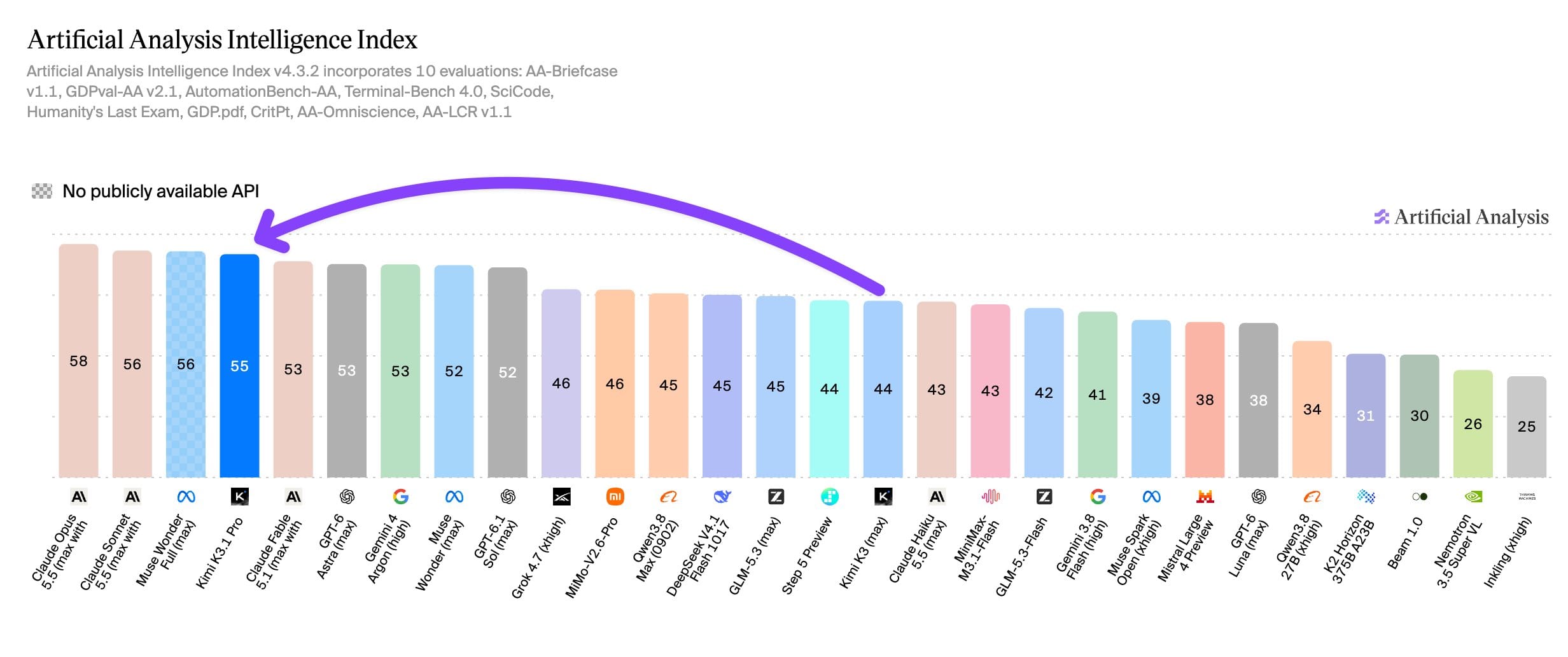
On the Artificial Analysis intelligence index, Kimi K3.1 Pro scored 55 points, an 11-point improvement over its predecessor, K3. With this result, the model secures fourth place in the global top ten, trailing only industry leaders such as Claude Opus 5.5, Claude Sonnet 5.5, and Muse Wonder Full. Notably, if Moonshot AI follows through with its plan to release the model’s weights by November 4, K3.1 Pro will become the most powerful open-weights model on the market, significantly narrowing the gap between open and closed systems.
The model demonstrates improved performance in agentic tasks. On the GDPval-AA benchmark, it achieved a score of 1,846 Elo, marking a significant leap from the previous version. Furthermore, the rate of "hallucinations" has been substantially reduced; according to Moonshot's internal testing, the incidence of incorrect information has dropped from 23.4% to 8.3%.
Innovations in 3D Modeling and Coding
A key advantage of Kimi K3.1 Pro is its integration with game engines such as Unity, Unreal Engine, and Godot. The model is capable of both minor code adjustments and building entire projects. A new feature, "3D Make," allows users to create, edit, and export 3D models directly on the Kimi.com platform, making it a powerful tool for engineers and architects.
Technically, the model maintains 2.8 trillion parameters, with 104 billion active. Its context window spans one million tokens, enabling it to process large volumes of data. Additionally, Moonshot has reduced token costs by 33%, making the model more accessible for businesses.
Security and the Future
Moonshot AI is placing a particular emphasis on cybersecurity. The company stated that during the training process, it specifically scrubbed data that could potentially be used for hacking. Despite this, the model retains high efficiency in identifying and auditing software vulnerabilities, making it useful for defensive purposes.
For users in Georgia, this development is significant as it increases the number of available alternatives in the AI market. Models like Kimi, which offer the prospect of open access, may increasingly integrate into creative and engineering industries, providing local developers and designers with new ways to work.