Measuring AI Agent Performance: A New Approach for the CPU
The rise of "Agentic AI" has created fresh challenges for hardware manufacturers. While the capabilities of AI agents have grown significantly in recent months, there is still no unified, standardised methodology to assess how a computer's central processing unit (CPU) handles these workloads.
What is Agentic AI and why must we measure it?
Agentic AI refers to systems equipped with large language models (LLMs) that can independently execute tasks. These agents do more than just generate text; they access various tools, such as file editing, code execution, or database management. The process where an agent sequentially uses these tools to achieve a goal is known as an "agentic loop."
The problem is that traditional benchmarks focus on graphics processing units (GPUs) and inference speed. However, when dealing with complex, multi-step tasks, the CPU's role becomes critical. Researchers are now developing a new approach to evaluate the contribution of the CPU and memory in isolation.
Testing methodology: Competition and workload
The new testing system is based not just on the performance of a single agent, but on parallel processes. It has emerged that when working with one agent, the GPU load is dominant, and CPU resources remain largely untapped. However, when multiple agents run on a single system simultaneously, calling various tools and executing code places significant strain on the processor.
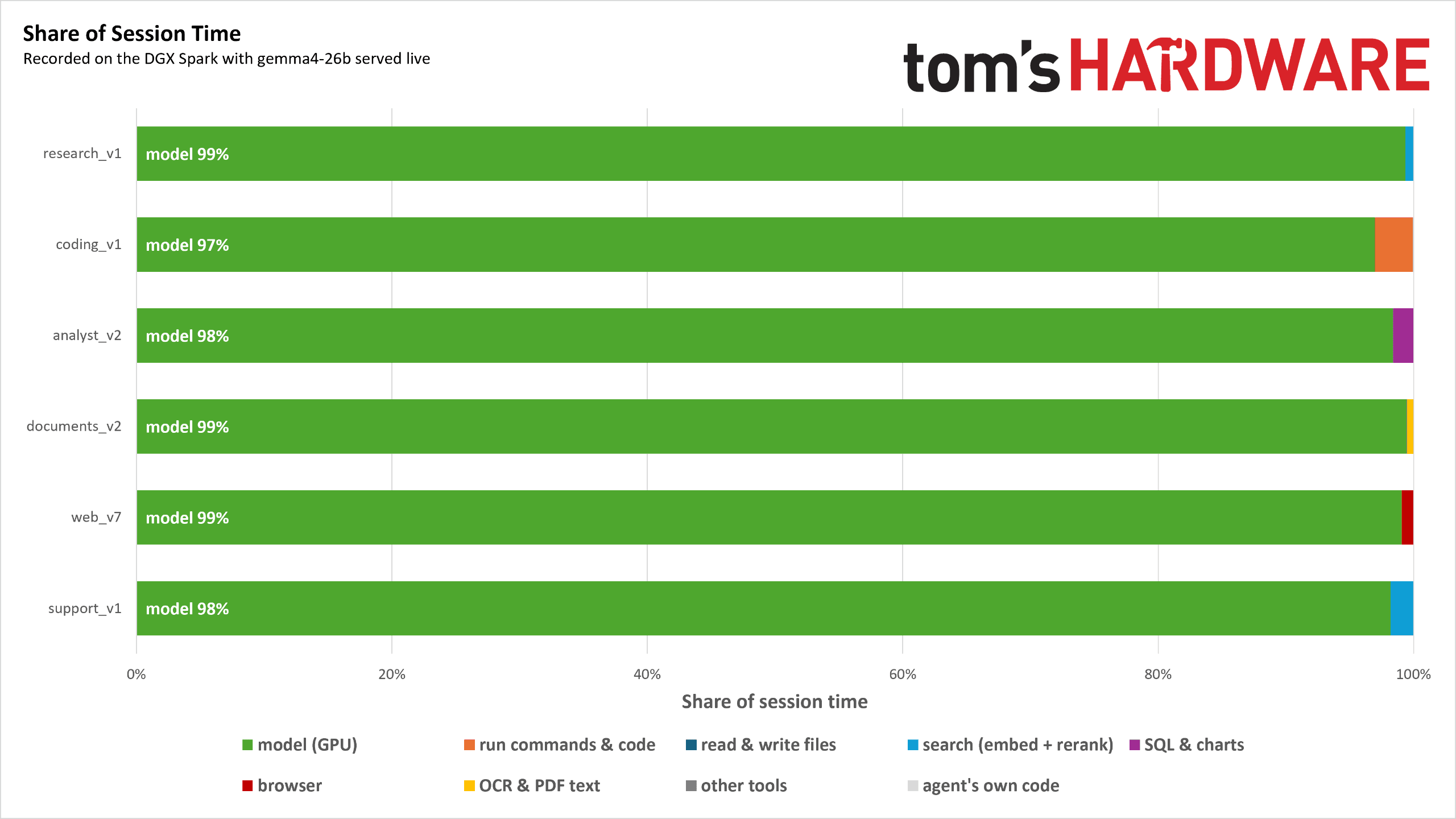
The testing process utilises agents built on the LangGraph platform, executing up to 30 different tasks. To ensure repeatability and stability, a proxy server is used to pre-record agent requests and responses. Consequently, the test uses a pre-recorded scenario instead of a real model, allowing the focus to shift entirely to CPU performance rather than the speed of the AI model itself.
What does this mean for users?
Although this methodology is still being refined, it paves an important path for evaluating future technologies. As Agentic AI becomes an integral part of our daily workflows, users will demand computers that not only excel at gaming or video editing but also efficiently manage autonomous AI agents.
In regions where the technology sector is actively implementing AI solutions, such standards will help in selecting appropriate workstations and server infrastructure. In the future, as hardware specifications become more clearly defined, these benchmarks will become a key guide for purchasing any high-performance system.