Inception Unveils Mercury 3: A Diffusion Model Outpacing GPT-6
The new model utilizes a diffusion-based approach to deliver speeds up to eight times faster than current industry leaders.

A new contender has emerged in the artificial intelligence sector. Inception has introduced Mercury 3, a diffusion-based language model that the company claims surpasses industry giants like GPT-6 Luna and Claude Haiku 5.5 in both speed and efficiency. This development is significant, as Mercury 3 operates on a principle fundamentally different from current standard models.
Technological Breakthrough: Why is Mercury 3 Faster?
Traditional language models, such as GPT or Claude, generate text sequentially, word by word, requiring each token to wait for the completion of the previous one. Mercury 3, however, employs a diffusion approach—a method previously used primarily for image generation. This system creates a rough draft of the response first, then refines it in several stages, allowing for the simultaneous processing of multiple words.
As a result, Mercury 3 generates 1,068 tokens per second on Nvidia graphics processors. For comparison, Claude Haiku 5.5 manages approximately 240 tokens, while GPT-6 Luna reaches 130. This four-to-eightfold increase in speed is critical for applications where latency must be kept to a minimum.
Real-World Results and Performance
Although independent testing is not yet available, data provided by Inception indicates that Mercury 3 leads in eight out of 12 categories. Its performance is particularly impressive in instruction following (IFBench) and autonomous programming (SWE-Bench Atlas). However, competitors still maintain an advantage in long-form text analysis and complex coding tasks.
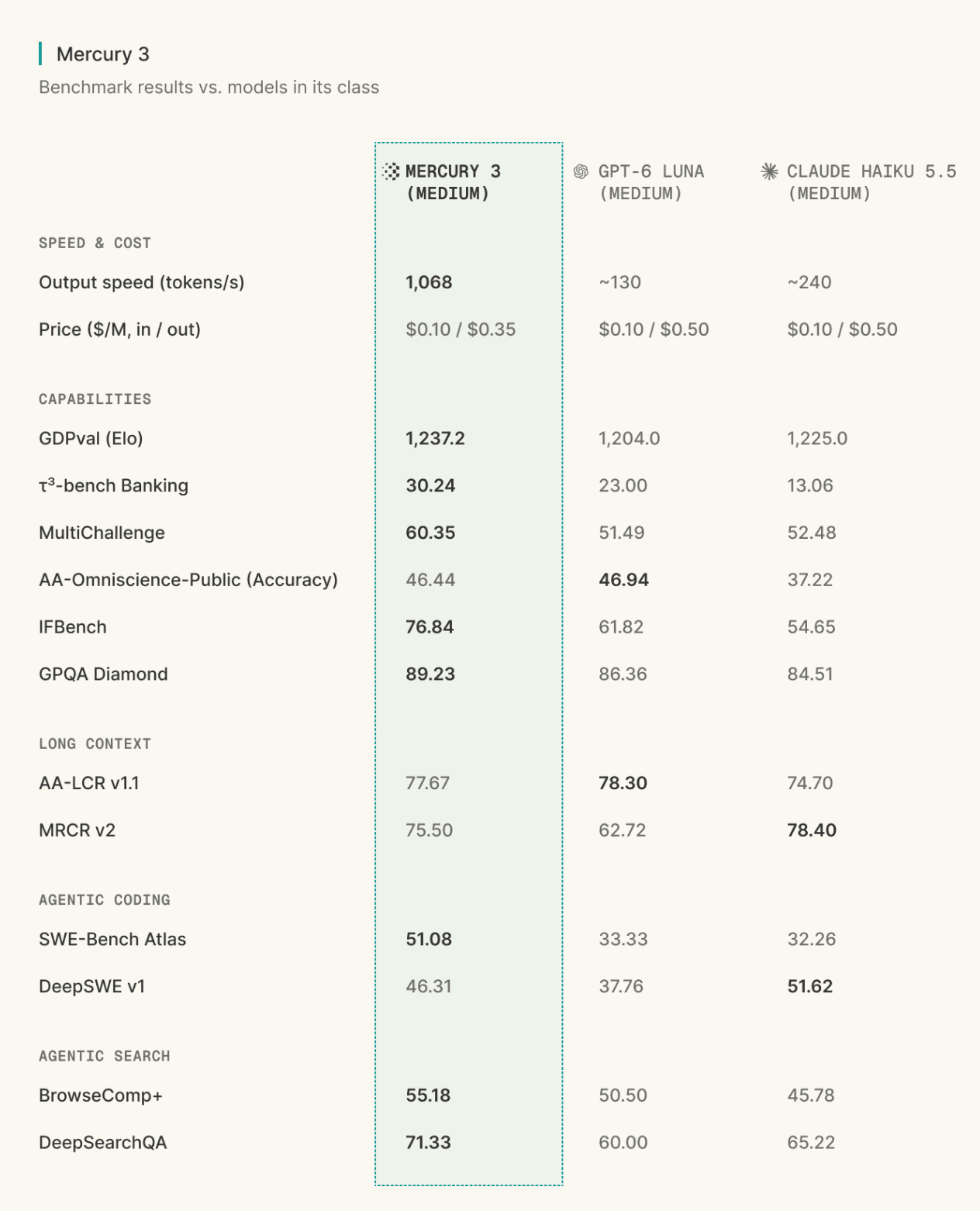
Early access partners, including smart glasses manufacturers and educational platforms, report that the model’s speed significantly enhances user experience. One partner noted that after implementing Mercury 3, response times dropped to 0.9 seconds, a milestone previously considered unattainable.
Availability and Pricing
Mercury 3 is now available on the Inception platform, as well as through OpenRouter, Baseten, and Vercel. The model supports the same API as OpenAI systems, allowing developers to transition to the new technology with ease. The pricing strategy is notable: the company is offering a 50% discount during the initial phase. In the long term, the model will be more expensive than competitors for short requests, but more affordable for longer, complex prompts.
Inception’s move confirms that diffusion models are increasingly becoming viable competitors to standard language models. While companies like Google are also working on similar technologies, such as DiffusionGemma, Inception’s effort to build a scalable and fast model promises significant market shifts. For developers working on real-time AI agents, this tool could soon become the new industry standard.