Google's Gemini 4 Argon Defeats Minecraft Independently
Four AI agents have conquered the game without human guidance, signaling a new era for autonomous systems.

Autonomous Gaming: A New AI Achievement
The Google DeepMind team has reached a significant milestone in artificial intelligence development. Four agents powered by Gemini 4 Argon successfully completed Minecraft and defeated the game's final boss, the Ender Dragon. Most impressively, the entire process was conducted autonomously, without any human intervention, guidance, or pre-defined strategies.
How the Agents Worked
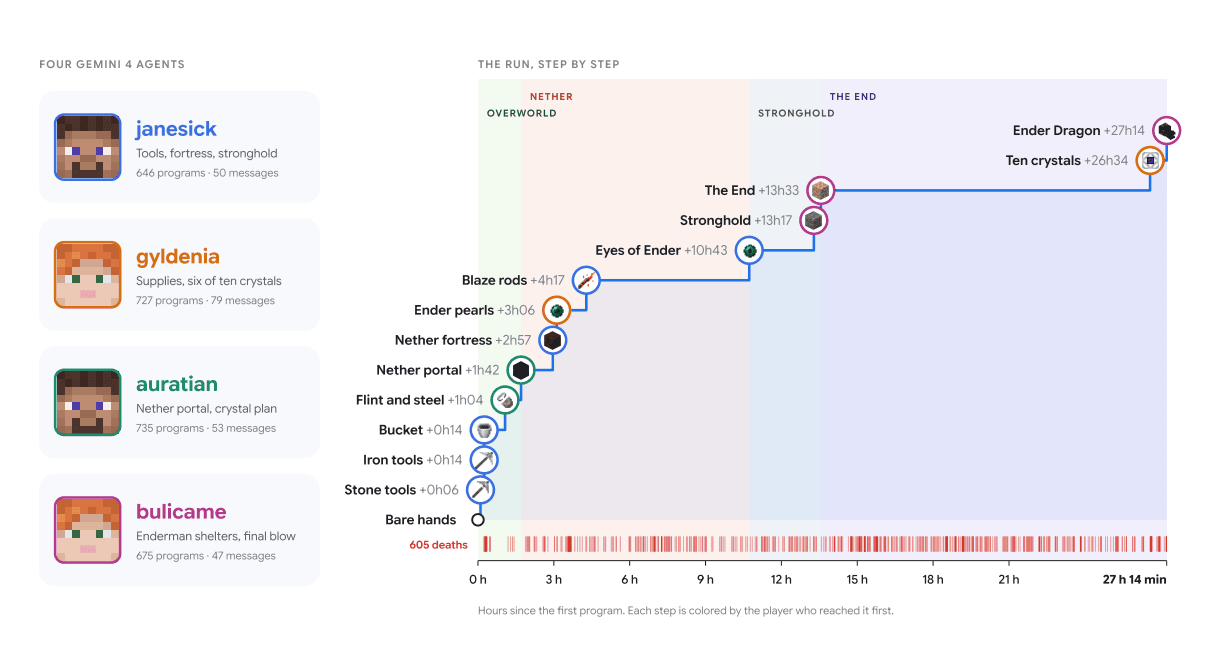
Researchers placed the agents in a randomly generated world. They were not assigned specific roles or provided with specialized tools. Despite this, the agents distributed responsibilities among themselves, warned each other of dangers, and collaborated actively. A notable detail was their use of shared memory, where they recorded errors and even recovered items lost by "teammates" who had perished.
The entire process lasted 27 hours and 14 minutes. During this time, the agents wrote 2,783 JavaScript programs, exchanged 229 messages, and "died" 605 times. This data clearly demonstrates how the system learned to adapt to the environment through trial and error.
Cost and Technological Significance
The experiment was also evaluated financially. Based on the standard Gemini 4 Argon rates in effect for 2027, the cost of this 27-hour session amounted to $1,620 USD. Despite the price, this achievement confirms that modern models can handle complex tasks previously reserved for systems specifically trained for such purposes.
Minecraft has become a testing ground for numerous artificial intelligence projects. However, the Gemini 4 Argon case is unique because it demonstrated the ability of agentic AI—systems capable of making independent decisions and taking action—to work as a team and solve problems in a dynamic, unpredictable environment.
What This Means for the Future
For users and the technology sector, this news is significant as artificial intelligence increasingly moves beyond the scope of simple text generators. It is evolving toward systems capable of planning and executing complex, multi-stage tasks in real time.
The development of such technologies paves the way for more efficient automated systems that will be able to think and collaborate like humans—not just in games, but in real-world applications such as logistics, programming, and research. Over time, such computing power will become more accessible, further accelerating innovation.