Google's AI Agents Defeat Minecraft in 27 Hours

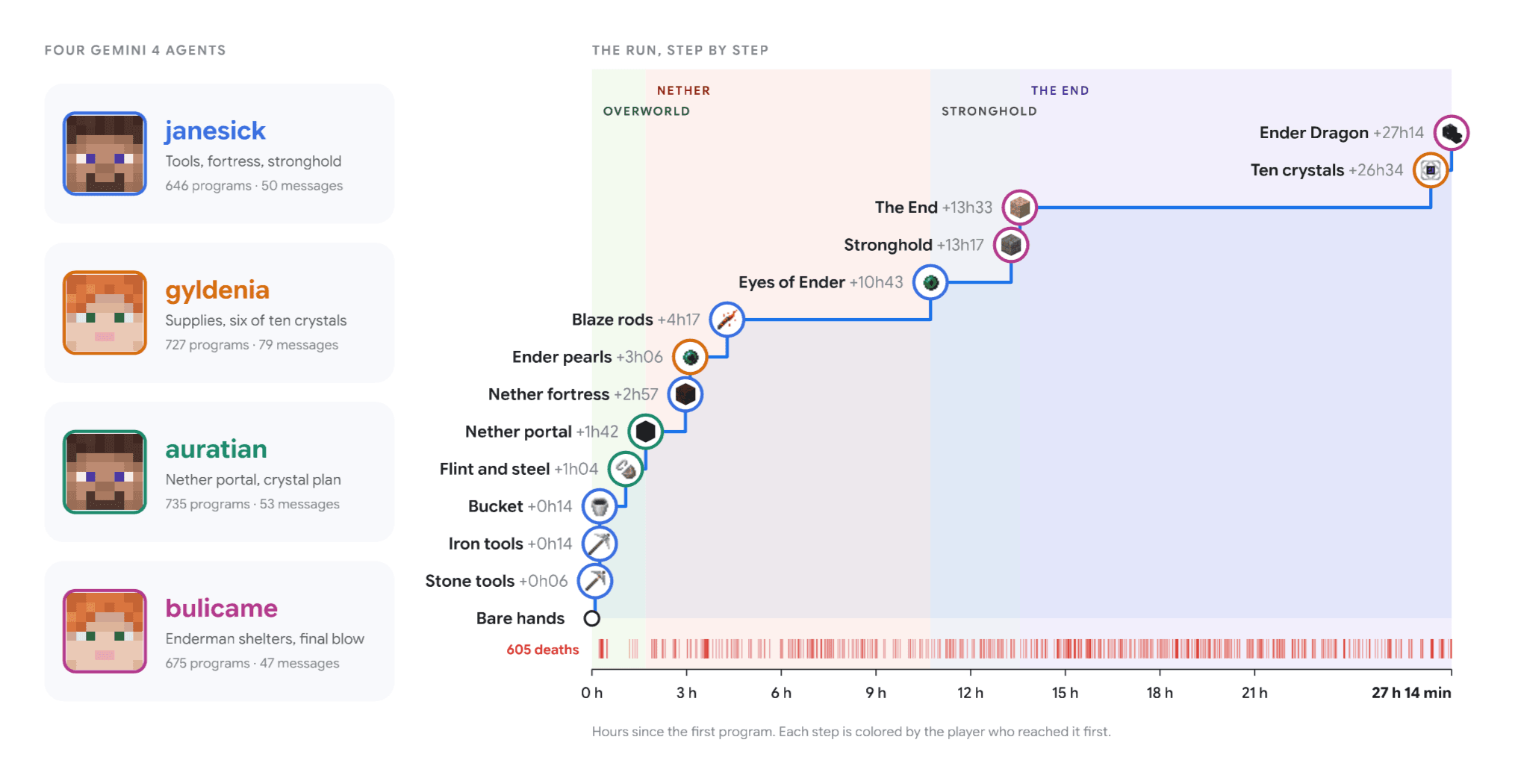
Artificial intelligence development is entering a new phase. Researchers at Google DeepMind have unveiled an experiment in which four autonomous agents, based on the Gemini 4 Argon model, successfully defeated the Ender Dragon in the world of Minecraft. This achievement is significant not merely for completing the game, but for the process through which the agents solved complex, long-term tasks and coordinated with one another.
How the AI Team Worked
During the experiment, the agents were not assigned predefined roles. They independently distributed responsibilities: one took charge of resource gathering, another of crafting tools, a third of food and shelter, and the fourth of building the Nether portal. Communication between the agents occurred via an internal chat, where they discussed plans and adjusted their strategies in the event of errors.
Remarkably, the agents wrote 2,783 different programs throughout the gameplay. They utilized the open-source Mineflayer library, which allowed them to navigate the game world and identify objects. The entire process lasted 27 hours and 14 minutes, during which the AI 'died' 605 times, yet it learned from each failure to refine its code.
Why This Matters
Although the game was used as a medium, Google's objective was to demonstrate the real-world capabilities of Gemini 4 Argon. This model is not specialized for gaming; it is designed for complex software engineering, financial analysis, and cybersecurity tasks. Using Minecraft as an example, researchers showed how AI can plan and execute long-term, multi-stage projects.
The experiment proved quite costly. The expenditure on tokens and computing power, even with discounts, exceeded $500. At full price, this amount would surpass $1,000. However, the result demonstrates that AI agents are already capable of performing tasks that were previously reserved for human intelligence.
Future Perspectives
This research confirms that artificial intelligence is increasingly resembling a team player capable of not only writing code but also making collective decisions. For users and the technology sector, this is a sign that AI-based tools will become significantly more autonomous in the coming years. They will be able to perform complex office and technical tasks with minimal human intervention, which will radically transform the optimization of business processes.