Attorney Upgrades Home Server to Optimize AI Performance
By upgrading his eight-GPU system, Mermiges has achieved higher precision for local AI processing.
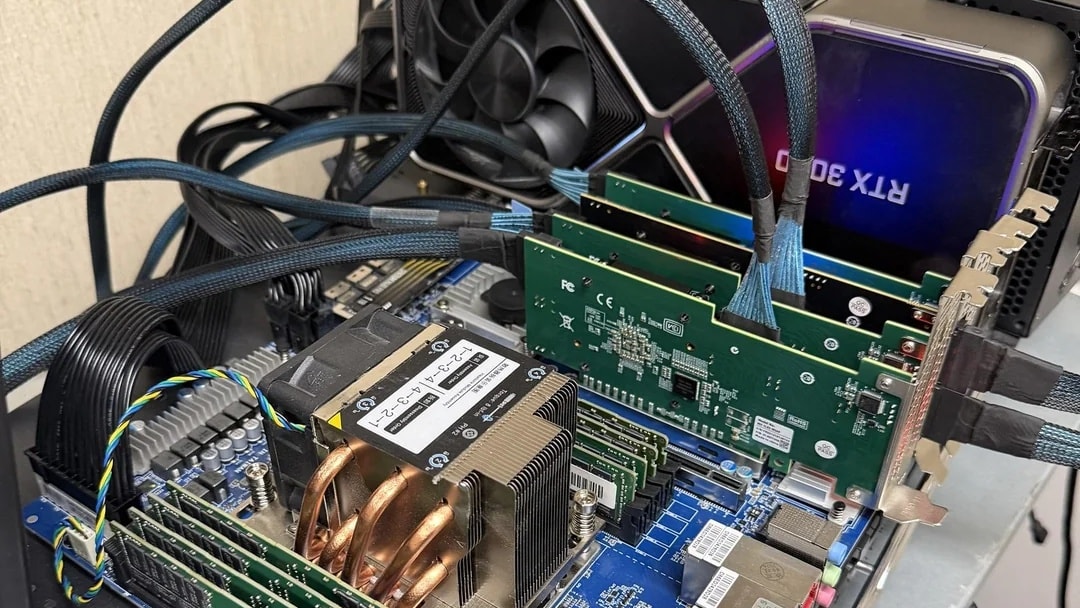
New Life for Older Hardware
Nick Mermiges, an attorney and technology enthusiast based in South Carolina, has launched an ambitious project to automate his legal practice. He upgraded his server, which is built on eight Nvidia V100 graphics cards, to run the DeepSeek V4.1 Flash model at a precision level known as near-NVFP4, up from its original 2-bit state. This adjustment ensures that the model’s most frequently used components—the so-called "experts"—operate with much higher accuracy, significantly improving the system's overall performance.
Originally dubbed "Volta sPLIt," the project has been renamed "Volta Max uPLIft." Mermiges added 1 terabyte of RAM and integrated an RTX 3090 graphics card. These upgrades were essential because loading the official DeepSeek weights at full precision into 256 gigabytes of VRAM was physically impossible. He found a solution in dynamic expert allocation: the most demanding components now run in 4-bit mode, while the remainder of the model stays in a 2-bit state.
Technical Challenges and Results
The attorney faced several hurdles while building the system. He initially suspected that frequent system crashes were caused by the PCIe slots, but the real culprit was the power supply unit (PSU). Once this was resolved, the server began operating stably. Interestingly, Mermiges utilized AI models themselves—Claude Code and Fable 5.2—to assist with software optimization, which helped with writing code and running benchmarks.
Although the increase in precision resulted in a 3 to 30% reduction in processing speed, the system gained multi-user support. The server can now process two requests simultaneously, leading to higher overall throughput. Tests confirmed that the model's responses are now much closer to the official high-precision version than they were under the previous 2-bit configuration.
Future Plans
Nick Mermiges has no intention of stopping. His goal is to keep all documents within his office on local servers to ensure maximum confidentiality. He plans to acquire eight more V100 cards to build a second server capable of handling parallel tasks. This approach demonstrates how an individual specialist can create high-level AI infrastructure with limited resources.
Projects like this are significant because they prove that with the right optimization, older, second-hand hardware can effectively run modern AI models. For tech enthusiasts, this serves as a prime example of how to reduce reliance on cloud services and build a private, controlled environment.