AI-Generated Photo Appears in Donald Trump’s White House Post
Questions Regarding Photo Authenticity
Former U.S. President Donald Trump posted a series of photos on his Truth Social platform intended to showcase the results of White House renovations. However, the post drew public attention not only for the scale of the work but also for visual inconsistencies. Internet users and technology experts quickly identified traces of manipulation in the imagery.
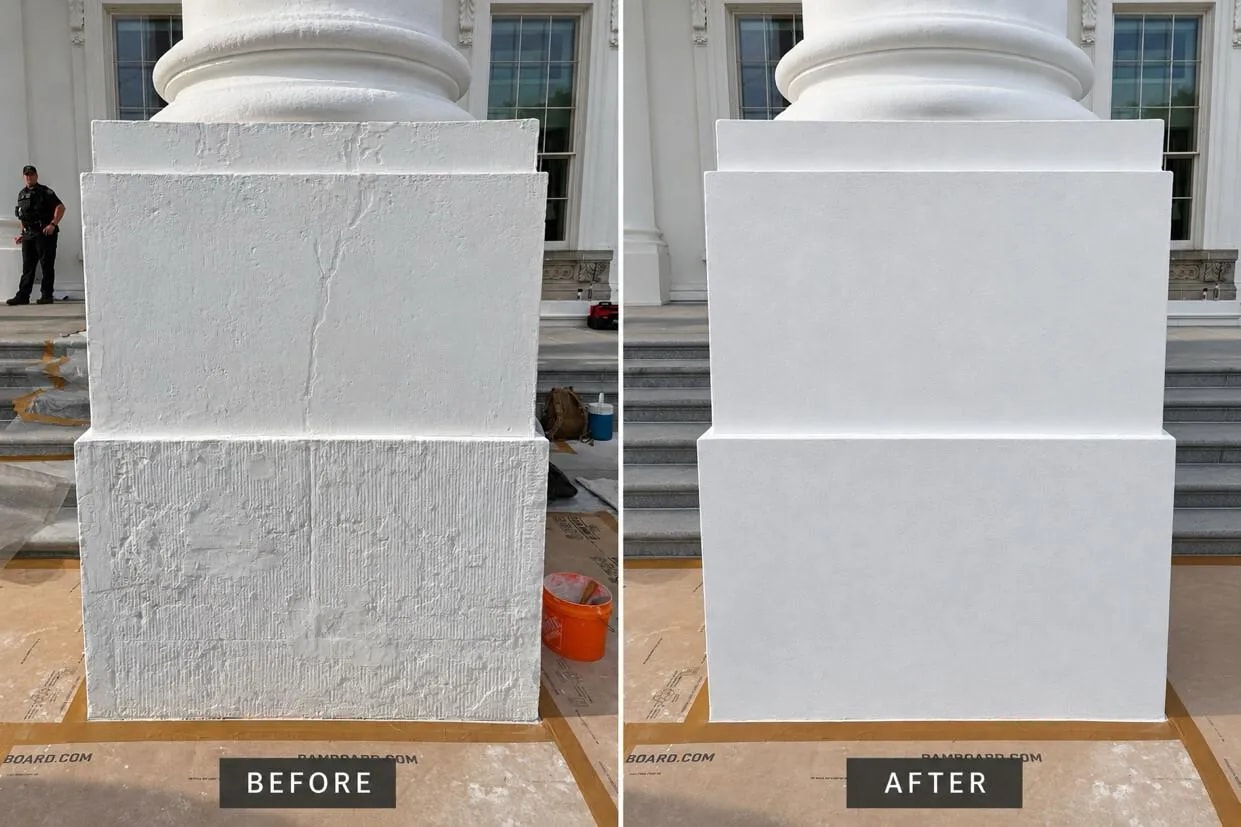
The controversial photo depicts a White House colonnade, comparing its state “before” and “after” the restoration. A Google-developed AI detector determined that the image was likely created or significantly processed using OpenAI technology. This incident highlights the ongoing challenges surrounding the verification of digital content authenticity in the modern era.
Details Indicating AI Intervention
Reddit users conducted a detailed analysis of the photo and discovered several obvious errors. The most prominent is the asymmetry of the staircase steps: the number of steps on either side of the structure does not match. Furthermore, compared to the “before” photo, the configuration of the steps in the new version differs drastically, which would be impossible in an actual construction project.
It is also worth noting that while the angles and details of the photos are suspiciously identical, certain parts of the image show unnatural reflections and textural changes. These characteristics are typical of images generated with the help of generative AI, as algorithms often struggle to maintain geometric symmetry and physical laws accurately.
Why This Matters
Although photo manipulation by political figures is not a new phenomenon, the use of artificial intelligence to “embellish” specific achievements raises new ethical questions. When public figures use AI technologies to alter reality, it diminishes trust in visual evidence.
For readers, this example serves as another reminder that any “evidence” seen in the digital space should be evaluated critically. AI-generated content is becoming increasingly convincing, yet small details—such as staircase steps or reflections—remain indicators that help distinguish reality from digital illusion.